THE SHORT ANSWER
What should you know first?
Compare home automation quotes using the same room-by-room scope, exact equipment and quantities, installation, configuration, tax treatment and support terms. Mark missing costs as unknown. A cheaper subtotal is not a saving unless both proposals deliver equivalent functions and include the same work.
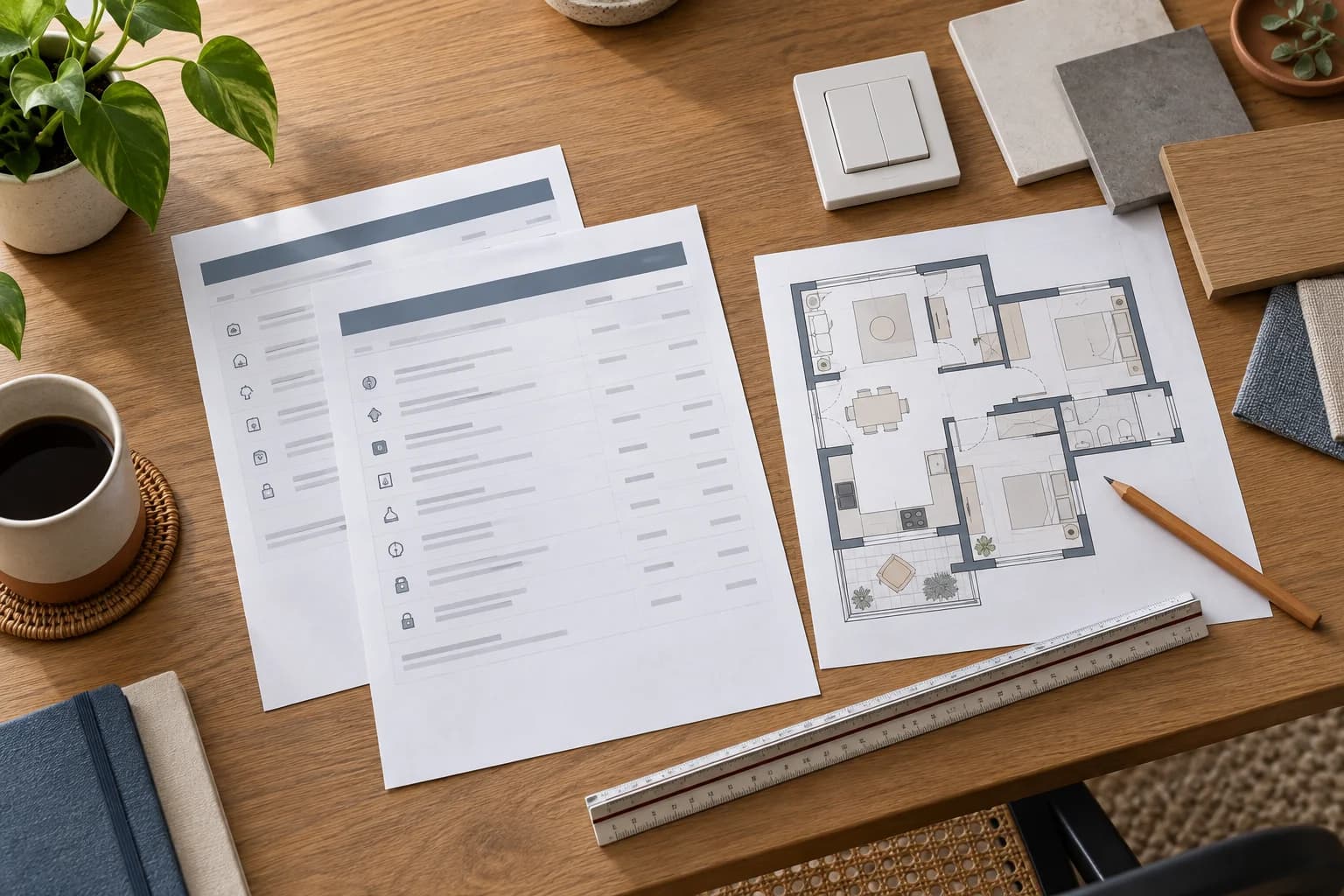
Side-by-side comparison
On smaller screens, scroll the table horizontally.
| What to compare | What to record for each proposal |
|---|---|
| Rooms and functions | The rooms, circuits, curtains and routines included |
| Exact equipment | Manufacturer, model, quantity and finish |
| Required dependencies | Controllers, gateways, power supplies and network equipment |
| Installation work | Wiring, box changes, mounting, labour and repairs to finishes |
| Configuration | Scenes, integrations, testing and family training |
| One-time amount | Equipment, labour, delivery and clearly stated tax treatment |
| Recurring charges | Subscriptions, storage, maintenance and chargeable service visits |
| Demonstrations | What the provider will show before handover |
| Responsibility | Who invoices, installs, configures and answers support requests |
| Commercial conditions | Validity, milestones, exclusions and how changes are priced |
Compare the same outcome first
Two quotations can both say “3 BHK automation” and describe very different projects. One may cover selected lighting circuits; another may include curtain motors, a controller, networking and configuration. A total price becomes useful only after you understand what each provider has included.
Write down what you want to happen in each room. For example: control the living-room lights from physical switches, close two curtains at bedtime, and adjust an existing air conditioner. These are requirements to discuss, not a complete technical design. Ask each provider to quote against the same list after checking the property.
Keep optional additions separate. This makes it easier to compare the essential project without confusing it with a different set of extras.
Build a shared comparison sheet
Use one row for each question and one column for each proposal. Record the provider's written answer and mark anything missing as “not confirmed”. Do not treat a blank as included or free.
Use Nexoforma's budget planner to organise allowances. Its example amounts are illustrative; replace them with your own figures or the provider's written amounts. It does not validate a quotation or establish a market price.
Work through an illustrative difference
Suppose Proposal A lists eight lighting controls and two curtain-control modules. Proposal B lists eight lighting controls, two curtain motors, tracks, installation and scene setup.
These descriptions are not equivalent. Ask Proposal A's provider whether motors and tracks are required, supplied separately, already present or excluded. Ask Proposal B's provider to identify the models, curtain dimensions covered and any electrical work still needed.
The answer may reveal that either proposal fits your property better. Do not add a guessed “missing cost” or assume the larger list is automatically the better design. Ask both providers to revise their scope in writing.
This example contains no supplier prices and does not describe a completed Nexoforma project.
Ask what will be demonstrated
A brand or protocol name alone does not tell you whether every function you want has been included. Ask the provider to identify the exact products and proposed features, then agree a demonstration appropriate to the design.
Questions to include:
Ask the qualified installer to plan and perform demonstrations safely. An internet outage and a loss of electrical power are different conditions; agree what each check is intended to establish.
- Can family members use the agreed physical controls without opening an app?
- Which agreed functions continue during an internet outage?
- How does the installed system recover after power is restored?
- Who owns the household accounts and how is installer access managed?
- What needs a subscription, and what changes if it ends?
- Who handles a problem that involves more than one brand or trade?
Separate purchase cost from ongoing commitments
Keep one-time installation costs and recurring charges in separate rows. Ask whether the quote includes configuration, delivery, applicable taxes and repairs to walls or joinery. Where an amount already includes tax, do not add the same tax again in your comparison.
For ongoing support, record the quoted period, renewal amount if provided, coverage, exclusions and visit charges. Treat an unquoted renewal as unknown. A product warranty and a provider's installation or maintenance commitment should be recorded separately.
These are questions for the actual supplier and contract; Nexoforma does not set the provider's terms or certify the quotation.
Resolve unknowns before choosing
Send each provider a short written list of missing information. Ask for a revised, dated proposal rather than relying on a phone explanation that never becomes part of the scope.
Compare the revised proposals against your priorities: required functions, compatibility evidence, complete scope, support arrangements and total commitments. If the proposals still describe different projects, return to the brief before selecting a price.
Keep the brief, final proposal, agreed changes and handover checklist together. This gives you and the selected professional a shared record of the intended result.
Prepare your next step
Use the free project brief and budget tools linked below to prepare your scope. You can also send Nexoforma a project enquiry. Enquiries are welcome from Tier 1, Tier 2 and Tier 3 cities across India; local availability is confirmed for each request. We ask before sharing your details with a named professional.
This is an original editorial planning checklist. It is not a hands-on system test, technical design or certification of a supplier quotation. The example is illustrative and contains no supplier prices.
How do you turn different quotations into a fair comparison?
Start by making a common scope sheet before comparing the bottom line. Give every room and required function a row, then record what each supplier includes for that row. Keep the supplier's original wording in a separate column. Your normalised description should explain the intended outcome without silently changing the offer. If one bidder prices curtain motors and another prices motors, tracks and installation, mark the difference before calculating any saving.
Use explicit statuses: included, optional, excluded and unknown. These labels prevent a blank cell from becoming an assumed zero. Where an item is optional, record whether it is necessary for the household's essential brief. A proposal can appear cheaper because important dependencies have been presented as optional extras. Ask the supplier to identify which parts are required for the quoted functions to work as described.
Freeze the comparison version while evaluating offers. If the scope changes during discussions, send the updated brief to each bidder and request a revised offer. A spreadsheet built from several different design revisions is not a reliable comparison, even when every amount has been copied accurately. Record the quotation date, validity, revision and the assumptions that still depend on a site visit.
Which commercial boundaries deserve their own columns?
Separate equipment, installation, configuration, coordination with other trades, delivery, taxes and recurring charges. These categories are a way to understand the offer, not a rule that every supplier must structure its invoice identically. When a supplier bundles several services, ask it to explain their scope clearly enough to compare with the alternatives. The goal is clarity, not forcing artificial precision into a genuinely combined service.
Distinguish commissioning from simply fitting equipment. Ask whether the price includes the agreed scenes, integration checks, user training and documentation. Identify any limit on configuration visits or later adjustments. A system that powers on but has not been configured for the household's routines may not represent the same completed outcome as a fully commissioned proposal.
Keep the support promise separate from the product warranty. Ask who responds, whether remote and on-site work are treated differently, and how travel or replacement labour is charged. Confirm the arrangement for the actual Indian property location. A manufacturer's warranty period and the installer's commitment to attend the site answer different questions, so neither should be used as a substitute for the other.
How should you compare quantities and units?
Match the unit before matching the price. A line described as lighting control could refer to one channel, one module, one room or a package of several functions. Ask for clarification when the unit is not explicit. Count the required functions from the room schedule, then ask the professional to show how the quoted equipment provides them. This is a reconciliation exercise, not a recommendation to design electrical loads yourself.
Check repeated equipment carefully. A controller needed once for the project should not be assumed to repeat in every room, while a device required at each location should not disappear into a single package line without a quantity. Finishes and variants can also affect product identity. Record the exact manufacturer identifier once selected and ask how any substitution will be approved.
Keep dependent items together in the comparison. If a proposed control needs another component or a specific interface, record that relationship so a lower-priced alternative does not omit it. The professional should confirm the compatibility of the complete combination. An online listing with a similar name is useful for research only after the exact model and its role have been established.
What can internet prices tell you, and what can they not tell you?
A public product price can help you ask informed questions about a hardware line. It does not establish that the same seller will supply the full project, provide installation in your city, configure the system or honour the same support arrangement. Record the seller, exact variant, currency, tax statement, shipping conditions and date checked. Treat availability and delivery as separate questions rather than conclusions drawn from the presence of a product page.
Compare like-for-like quantities and packs. A lower unit-looking price may refer to a different pack size, finish, generation or regional product. Ask the supplier about warranty and support for the proposed source. Do not assume a foreign listing becomes an equivalent Indian offer after a currency conversion. The delivered price and local service route need their own evidence.
When a public price cannot be found, label the amount unknown or quotation required. Do not generate an apparently precise number from a different category of product just to fill the table. Missing information is valuable because it identifies the next question. A comparison that openly shows unpriced installation or dependencies is more useful than a complete-looking total assembled from incompatible assumptions.
How do you avoid false savings calculations?
Only calculate a price difference between equivalent scopes. If one figure covers equipment and another covers equipment, installation and support, the subtraction does not measure savings on the same outcome. Show a priced-items subtotal for an incomplete alternative and list the missing costs beside it. Avoid presenting a percentage advantage until the unresolved items have been addressed or explicitly excluded from both sides.
Keep tax treatment consistent. Record whether the supplier's amount is inclusive, exclusive or unspecified. If a planning allowance is used while waiting for clarification, label it as your assumption and show it separately from the quoted figure. Do not add tax again to an inclusive amount or assume all line items share the same treatment. Obtain the actual invoicing explanation from the supplier.
Use a simple arithmetic check for each offer. Multiply quantities by unit rates where appropriate, reconcile discounts and additions, and compare the result with the supplier's stated total. If they differ, ask for a corrected quotation instead of silently replacing the supplier's amount. A calculation discrepancy may have an explanation, but it should be resolved in the commercial document you rely on.
What should a clarification request look like?
Send a short numbered list that refers to the quotation revision and specific line items. Ask one question per item so the reply can be recorded against the comparison sheet. For example, ask whether the curtain line includes the track, motor, installation, interface and power provision, then ask who supplies any exclusions. This is easier to assess than a general request to confirm that everything is included.
Group design questions separately from commercial questions. A compatibility explanation may need the integrator or manufacturer documentation, while a payment or delivery question belongs to the supplier's commercial team. Record the source of each answer and ask for important changes to be reflected in the revised quotation. Verbal explanations can inform a discussion, but the final scope should not depend on your memory of them.
Give bidders the same opportunity to respond to newly discovered requirements. If one clarification reveals that network work is required, share that requirement consistently where relevant. You can still evaluate how proactively each candidate identified dependencies. Fair comparison means the final offers address the same project, not that every supplier must have reached its recommendation through an identical process.
How can you score value beyond price?
Create a small scorecard with categories that reflect the household's priorities. These might include clarity of the brief, usability, compatibility evidence, installation coordination, ownership documentation and support arrangements. Decide the relative importance before seeing the final prices. The scorecard is your decision tool; it is not an official accreditation or a public ranking of installers.
Attach evidence to every score. A high mark for usability should refer to an actual demonstration or a clearly described interaction. A support score should refer to the written service arrangement for your location. Where evidence is missing, mark the uncertainty rather than filling it with an average score. This keeps an attractive sales presentation from overshadowing unanswered practical questions.
Use the result to structure a family decision. One household may prefer a simpler system with clearer ownership; another may value a specific integration enough to accept additional complexity. Neither preference requires a universal winner. The best documented choice explains which trade-offs were accepted and what the appointed supplier is expected to deliver.
How should revised scope and payment discussions be recorded?
Once you choose an approach, consolidate the selected functions, equipment, exclusions and service commitments into the final commercial documents. Identify the approved room schedule and quotation revision. If optional items are removed to meet the budget, confirm whether any related shared equipment or configuration also changes. A lower total should be the result of an explicit scope decision, not an unexplained discount accompanied by hidden substitutions.
Discuss progress evidence for payment milestones with the supplier. Relevant stages might include procurement confirmation, equipment delivery, installation, commissioning and handover. The appropriate terms depend on your contract and circumstances, so obtain professional advice where needed. Nexoforma does not prescribe a universal payment percentage or provide legal approval of the agreement.
During delivery, keep a change log tied to the same baseline. Every approved change should explain the old requirement, the new requirement, the cost effect and any impact on timing or other trades. Update the comparison and working budget where useful, but preserve the original offer for reference. This makes the final project cost understandable rather than a collection of unrelated additions.
Questions buyers commonly ask about comparing quotes
Should I always collect three quotations? Several comparable offers can help, but the number alone does not create a good decision. Two clearly scoped proposals may be more useful than three vague packages. Use your available shortlist responsibly and check whether the providers have actually assessed the same requirements and property conditions.
Can a supplier charge more than an online hardware price? A project offer may include services and responsibilities absent from a retail listing. Ask for those services to be explained, then decide whether the overall value fits your needs. A public price is a research reference; it is not automatically the correct installed project price or proof that a different quotation is unreasonable.
Will Nexoforma produce real supplier quotations automatically? No. The live planning tools help you prepare a brief and working budget. Quotation upload and AI-assisted research are still under implementation. Any future researched alternatives will be labelled estimates with sources and missing costs; they must not be presented as binding offers from suppliers who have not issued them.
What is the best next step if my offers are impossible to compare? Return to the room-and-function schedule, identify the largest scope gaps and request written clarification. If the underlying design is still unsettled, resolve it with the appropriate professionals before treating the offers as final. A clearer brief usually contributes more to the decision than another round of unexplained headline discounts.
Frequently asked questions
Questions buyers commonly ask about comparing quotes
Should I always collect three quotations? Several comparable offers can help, but the number alone does not create a good decision. Two clearly scoped proposals may be more useful than three vague packages. Use your available shortlist responsibly and check whether the providers have actually assessed the same requirements and property conditions.
Questions buyers commonly ask about comparing quotes: point 2
Can a supplier charge more than an online hardware price? A project offer may include services and responsibilities absent from a retail listing. Ask for those services to be explained, then decide whether the overall value fits your needs. A public price is a research reference; it is not automatically the correct installed project price or proof that a different quotation is unreasonable.
Questions buyers commonly ask about comparing quotes: point 3
Will Nexoforma produce real supplier quotations automatically? No. The live planning tools help you prepare a brief and working budget. Quotation upload and AI-assisted research are still under implementation. Any future researched alternatives will be labelled estimates with sources and missing costs; they must not be presented as binding offers from suppliers who have not issued them.
Questions buyers commonly ask about comparing quotes: point 4
What is the best next step if my offers are impossible to compare? Return to the room-and-function schedule, identify the largest scope gaps and request written clarification. If the underlying design is still unsettled, resolve it with the appropriate professionals before treating the offers as final. A clearer brief usually contributes more to the decision than another round of unexplained headline discounts.
Continue your research
Put your questions into a project brief.
Tell us your priorities and location in India. We will review your request as our professional network grows.
Plan my project →Build a free budget · Draft a project brief · Compare quotations · Check a quote with Ved
Found something that needs correcting? Tell our team. This guide is a planning checklist, not a site-specific design or electrical instruction.
← All guides