THE SHORT ANSWER
What should you know first?
Count independent listening choices before comparing Amp and Amp Multi. Ask a professional to map zones, outputs, speakers and cable routes, then price the complete installation. Several Amp units and one Amp Multi are not automatically equivalent; local supply, mounting, configuration and supported inputs need confirmation.
Our recommendation
Shortlist Amp for a single wired music zone. Include Amp Multi in an integrator-led comparison for several independent zones with cables returning to a rack. Its global partner availability announcement still needs a local supplier quotation and delivery commitment.
Original editorial analysis of manufacturer documentation, not a hands-on review. Prices are a dated website snapshot, not a live offer. Confirm the delivered Indian price, taxes, availability and warranty before purchasing.
Side-by-side comparison
On smaller screens, scroll the table horizontally.
| What to compare | Amp | Amp Multi |
|---|---|---|
| Amplified outputs | 2 channels | 8 outputs |
| Published power at 8 ohms | 125 W per channel | 125 W per output |
| Independent zones per unit | 1 | Up to 4 configurable zones |
| India website price checked | ₹74,999 | Not verified; installation partner quote needed |
| Installation emphasis | A wired speaker zone | Rack-based multi-zone installation; rack mount sold separately |
Table sources: [1] Sonos India: Amp, price and technical details[2] Sonos newsroom: Amp Multi specifications and availability
What is new in 2026?
Sonos announced Amp Multi in January 2026. Its current announcement states global availability through installation partners from 25 August 2026. The design supports flexible output-to-zone assignment and introduces ProTune manual adjustment tools. We have not confirmed an Indian public price or local stock.
Sources: [2] Sonos newsroom: Amp Multi specifications and availability
Count independent music choices, not just speakers
Write down which areas must play different sources at the same time. A living room and dining area that always share music might belong to one zone; a bedroom and study with different listeners might need separate zones. The answer determines how useful additional independent zones are.
Our preference for a multi-zone rack begins with the wiring plan and service access. If speaker cables already return to a common equipment location, a consolidated design is worth pricing. If rooms are being added gradually, ask the installer to compare the cost and disruption of both approaches. Neither arrangement is automatically cheaper.
Compare a complete bill of quantities
At the checked India website price, four Amp units would total ₹2,99,996 in amplifier hardware. This is an arithmetic baseline, not a claim of functional equivalence to Amp Multi or a four-room installation price. Without a confirmed local Amp Multi quote, a savings claim would be premature.
Ask both proposals to include speakers, cable routes, mounting, network equipment, rack space, tuning and handover. If a room also needs TV audio, have the installer document that input path rather than assuming every zone amplifier provides the same connections.
Have the professional validate the speaker load
Published watts are only one part of a speaker-system design. Have the integrator identify the speaker model, impedance, wiring arrangement and supported load for each output. Do not extend a manufacturer-specific speaker-count claim to arbitrary third-party speakers.
Before sign-off, play different sources in the intended zones, check volume limits and confirm that room names match the household's language. Label the rack and retain the final output-to-room schedule so later maintenance does not start by tracing every cable.
- Local supply date, warranty responsibility and delivered price in writing.
- Independent zones and speaker outputs shown separately.
- Rack mount, ventilation space and service access included.
- TV inputs, tuning and acceptance demonstration explicitly scoped.
Why should an audio plan begin with independent listening areas?
The first planning question is how many areas need to choose different music at the same time. A house can contain many speakers while using relatively few independent listening choices. Conversely, a smaller property may need separate sources for people working or relaxing in different rooms. Write those simultaneous-use scenarios before comparing amplifier quantities. This turns the word zone into a specific household requirement rather than a vague equipment label.
Distinguish a physical room from a listening zone. An open kitchen and dining area might normally share music, while two parts of a larger space may have different uses. Ask the integrator to explain the proposed grouping and what the household can change during everyday use. Do not assume that the number of speaker outputs establishes the same number of independent sources or app-controlled areas.
The table above describes the manufacturer-published product distinction and a dated price reference. Nexoforma has not installed or measured a comparative Amp and Amp Multi system. The following guidance helps you assess a professional design and quotation. It does not provide a speaker-wiring instruction, a load calculation or a guarantee that either arrangement is appropriate for a particular property.
What belongs in a room-and-zone schedule?
For each area, record its name, normal activity, desired source independence, expected volume control and the proposed speaker locations. Note whether television audio or an external source is part of the requirement. Keep unresolved decisions visible. A zone schedule can begin as a simple planning document and then be developed by the audio professional into the appropriate technical design.
Use the same room names in drawings, equipment labels and the user interface. If cables are labelled lounge but the app says living room, document the relationship or standardise the naming. Clear labels matter especially when several speaker runs return to a common equipment location. They help the household choose the correct area and help future technicians understand what each output serves.
Separate current scope from later additions. A future room should not be silently included in the advertised independent-zone count if its speakers, wiring or configuration are absent from the quotation. Ask what is installed now, what capacity is being reserved and what would need to be purchased later. This makes a phased proposal easier to compare with a complete installation.
How do centralised and distributed equipment locations affect planning?
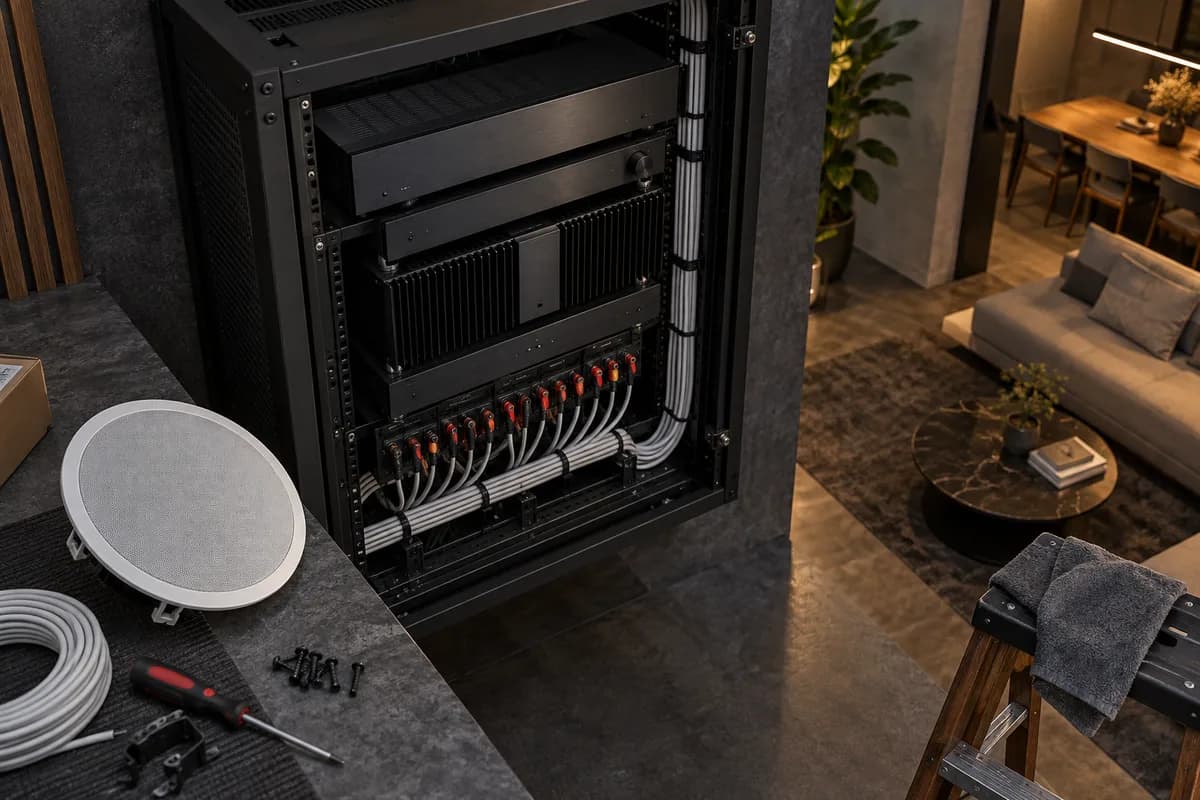
A central equipment location can consolidate several parts of an installation, but it also requires suitable cable routes, access, power and environmental conditions. Ask the professional to explain why the proposed location is appropriate for the selected equipment. The architecture should follow the property and service requirements, not simply the appeal of a tidy rack photograph.
A more distributed arrangement can involve equipment located nearer individual listening areas. That may suit some project conditions, but the network, power and service-access requirements still need coordination. Ask how each unit will be reached for maintenance and how the household will understand the overall system. Distributed does not automatically mean easier, and centralised does not automatically mean cheaper.
Compare both approaches using the same functional schedule. Include equipment, speaker cabling, network work, mounting, configuration and access arrangements. The decision may change if a property already has suitable cable routes or if the project is being installed in phases. A general article cannot settle those conditions without a professional assessment of the site.
What should you ask about speaker selection and load?
Ask the integrator to identify the exact speakers, their intended placement and the supported electrical arrangement for each amplifier output. Published amplifier power is only one part of that design. Speaker characteristics, wiring and manufacturer limits must be considered by the responsible professional. Do not infer a safe speaker count from a different installation or from a claim that applies only to a specific speaker combination.
Keep the technical design responsibility explicit. The homeowner can define listening goals and visual constraints, while the specialist validates the equipment and installation. If an interior designer selects an architectural speaker appearance, the audio professional should still review its suitability for the proposed amplifier arrangement. A finish or size preference should not bypass that assessment.
Request a final output-to-speaker schedule at handover. It should make clear which room and speaker run is connected to each relevant output. Appropriate labelling supports later service and reduces guesswork. Nexoforma's planning tools can record the agreed scope, but they are not intended to calculate speaker loads or authorise changes to an installed audio circuit.
How should television audio change the brief?
A music zone and a television-audio zone can require different input and control arrangements. State explicitly which rooms need television sound and identify the exact television and any other source equipment. Ask the integrator to document the supported signal path, the intended volume control and any limitations. Do not assume every zone in a multi-zone proposal offers the same connections or behaviour.
Demonstrate the everyday sequence. Turn on the intended source using the planned remote or control, select the relevant audio path and adjust the volume. If several products are involved, ask what happens when one is replaced or updated. The system should be assessed as the household will use it, not only as an amplifier playing a test track from a dealer's source.
Keep the television scope separate in the quotation where it adds equipment or programming. This helps avoid comparing a music-only proposal with one that includes additional media integration. A difference in total price can be justified by different functions, but that difference should be visible rather than hidden behind a broad whole-home audio label.
What rack and installation costs can be missed?
Ask for the mounting accessories required by the exact equipment and the proposed layout. The manufacturer information notes the separate rack-mount consideration for Amp Multi; confirm what the supplier is actually including. Also discuss cable management, labels, service access and the power/network arrangement. A rack-based price that covers only amplifier hardware is not a complete installed system price.
Have the professional coordinate ventilation and clearances using current manufacturer guidance. Do not choose a cabinet solely by whether the products appear to fit in a drawing. Consider how a technician accesses connections and replaces equipment without disturbing unrelated work. The appropriate arrangement depends on the selected devices and the property, so ask for a project-specific explanation.
Record the boundary with joinery and electrical work. The audio specialist may specify requirements while another trade provides the cabinet, supply or cable routes. Put those responsibilities in the scope sheet. This prevents necessary work from being omitted because every supplier assumes another business has already included it.
How should you compare Amp and Amp Multi prices in India?
Compare current written local quotations for the exact complete configurations. The checked Amp price above is a dated hardware reference. Multiplying it by several units provides an arithmetic baseline, but it does not establish functional equivalence to Amp Multi or a saving against a product whose local delivered price has not been verified. Keep that distinction explicit in any comparison sheet.
Request separate identification of speakers, amplification, mounting, cable work, network additions, configuration, tuning and handover. Ask whether taxes, delivery and any site visits are included. If one option uses existing infrastructure and another requires new work, show those assumptions clearly. A fair cost comparison should explain the project conditions under which each total was prepared.
For Amp Multi, ask the installation partner for the actual Indian supply date, warranty handling and complete delivered amount. A global availability announcement does not confirm local inventory or an appointment slot. Avoid paying on the basis of an assumed launch schedule or an informal statement that stock will arrive soon. The supplier's written commitment is the relevant purchasing evidence.
What should tuning and commissioning mean in the contract?
Ask the professional to describe the setup and tuning work included for each zone. The scope should explain the intended result and the process for checking it, rather than relying only on the name of a software tool. A product offering adjustment capabilities does not establish that your quotation includes time for a careful room-by-room review.
Use normal listening material and realistic listening positions during acceptance. Check independent source selection, grouping where intended, volume behaviour and the names shown to the household. Ask the installer to explain any limits or dependencies. Do not judge the whole installation solely by the loudest demonstration or a single well-chosen track in the easiest room.
Record unresolved issues with their locations and next actions. A room might need a naming change, an adjustment or further investigation by another trade. Keep those items distinct from new requirements introduced after the original scope. A clear commissioning record helps both the customer and supplier understand what remains to complete the agreed work.
How can phased audio avoid stranded purchases?
Choose a first phase that delivers a usable listening outcome. If the plan begins with one area, ask what equipment and infrastructure are required for that area alone and what additional work would support the named later phases. The right answer depends on the wiring and future use assumptions. Buying several devices early is not automatically a better investment than preserving suitable routes and access.
Ask how later independent zones would be added. Identify the hardware, cable and configuration changes instead of accepting an unspecified promise of expansion. If the future layout is uncertain, record that uncertainty. A spare output or a free rack position does not by itself guarantee support for every later source or control requirement.
Revisit the plan before each expansion. Furniture, room use and the household's listening habits may change. Compare the new requirement with the installed schedule and ask the integrator to update documentation after the work. Phased ownership is easier when the project has a clear baseline rather than a collection of purchases made without a shared design.
What account and everyday-control questions matter?
Agree who owns the system account and how other household members use the intended functions. Demonstrate source selection, grouping, volume and recovery from common user mistakes. Keep the interface aligned with the room names in the drawings and cable schedule. The best technical plan still needs to make sense to the people choosing music every day.
Ask how the owner can obtain help when a zone behaves unexpectedly. Identify the first support contact and the information it needs, such as room name, source and observed behaviour. Avoid sharing passwords or private account details in a general support message. The service arrangement should explain remote diagnosis and site attendance without assuming the homeowner will investigate technical wiring.
Document any recurring services separately. Music subscriptions, optional support arrangements and other paid services should be identified by their actual role. Do not assume the amplifier itself implies a particular recurring cost or that every service used in a demonstration is included in the hardware price. The quotation and account setup should make those distinctions clear.
What should happen if equipment or a supplier changes later?
Keep an installed equipment list and the final zone/output schedule. Ask which configuration records are available to the owner and what a future professional would need to assess the system. Appropriate documentation does not guarantee that every alternative product is interchangeable, but it provides a useful starting point for maintenance and redesign.
Discuss the warranty path for equipment located in a rack or another coordinated installation. Ask who diagnoses a suspected fault, removes equipment safely and reinstates the system after replacement. Hardware warranty and installation labour may be different commitments. The homeowner should know which business handles each step and whether travel or reconfiguration is chargeable.
When adding or replacing a source device, have the integrator review the intended connection and control path. A new television or another media product can change the assumptions used in the original design. Record the revised arrangement after commissioning. The aim is to keep the working system understandable over time, not to promise that every future change will require no intervention.
Two illustrative audio-planning examples
A household wants one wired music area in a living and dining space that normally shares a source. Its integrator assesses an Amp-based proposal, confirms the speakers and wiring, and prices the complete installation. The decision focuses on that usable zone and any named future additions. The family does not treat an arbitrary count of speakers as proof that several independent zones are necessary.
Another project has several areas whose users want different sources at the same time, with speaker cables planned to return to an equipment location. The integrator includes Amp Multi in a comparison with other appropriate arrangements. It explains the output assignment, rack requirements, network work and local supply conditions. The owner evaluates the complete design and support path rather than choosing solely from the amplified-output count.
These examples describe planning logic, not completed Nexoforma installations or prescribed wiring designs. The actual choice needs a professional assessment and a current local quotation. Use the free project brief to record listening areas and simultaneous-use scenarios, then ask the supplier to translate them into a documented technical proposal.
Common questions about wired multi-room audio
Do eight outputs mean eight independent music choices? Do not make that assumption. Read the manufacturer zone specification and ask the integrator to show the actual output-to-zone arrangement. Outputs, speakers, physical rooms and independent sources are different parts of the design and should appear separately in the proposal.
Is Amp Multi always cheaper than several Amp units? That cannot be concluded without a comparable local quotation. Include the necessary mounting, cabling, speakers, configuration and support, and confirm that both alternatives deliver the same required functions. Hardware arithmetic alone is not an installed-system comparison.
Can I connect additional speakers myself later? Have a qualified audio professional validate the proposed load and wiring against manufacturer requirements. Do not extend a published speaker-count statement to unrelated products or configurations. Use the documented expansion plan and obtain an updated schedule after authorised changes.
Sources and verification
Frequently asked questions
What account and everyday-control questions matter?
Agree who owns the system account and how other household members use the intended functions. Demonstrate source selection, grouping, volume and recovery from common user mistakes. Keep the interface aligned with the room names in the drawings and cable schedule. The best technical plan still needs to make sense to the people choosing music every day.
What account and everyday-control questions matter?: point 2
Ask how the owner can obtain help when a zone behaves unexpectedly. Identify the first support contact and the information it needs, such as room name, source and observed behaviour. Avoid sharing passwords or private account details in a general support message. The service arrangement should explain remote diagnosis and site attendance without assuming the homeowner will investigate technical wiring.
What account and everyday-control questions matter?: point 3
Document any recurring services separately. Music subscriptions, optional support arrangements and other paid services should be identified by their actual role. Do not assume the amplifier itself implies a particular recurring cost or that every service used in a demonstration is included in the hardware price. The quotation and account setup should make those distinctions clear.
Continue your research
Put your questions into a project brief.
Tell us your priorities and location in India. We will review your request as our professional network grows.
Plan my project →Build a free budget · Draft a project brief · Compare quotations · Check a quote with Ved
Found something that needs correcting? Tell our team. This guide is a planning checklist, not a site-specific design or electrical instruction.
← All guides