THE SHORT ANSWER
What should you know first?
Compare Sentido and Fibonacci around everyday usability, label preferences, the exact system variant and the complete installed scope. Audition the proposed actions with the household and review finish samples in context. Confirm model references, mounting requirements, customisation and a written Indian quotation before procurement.
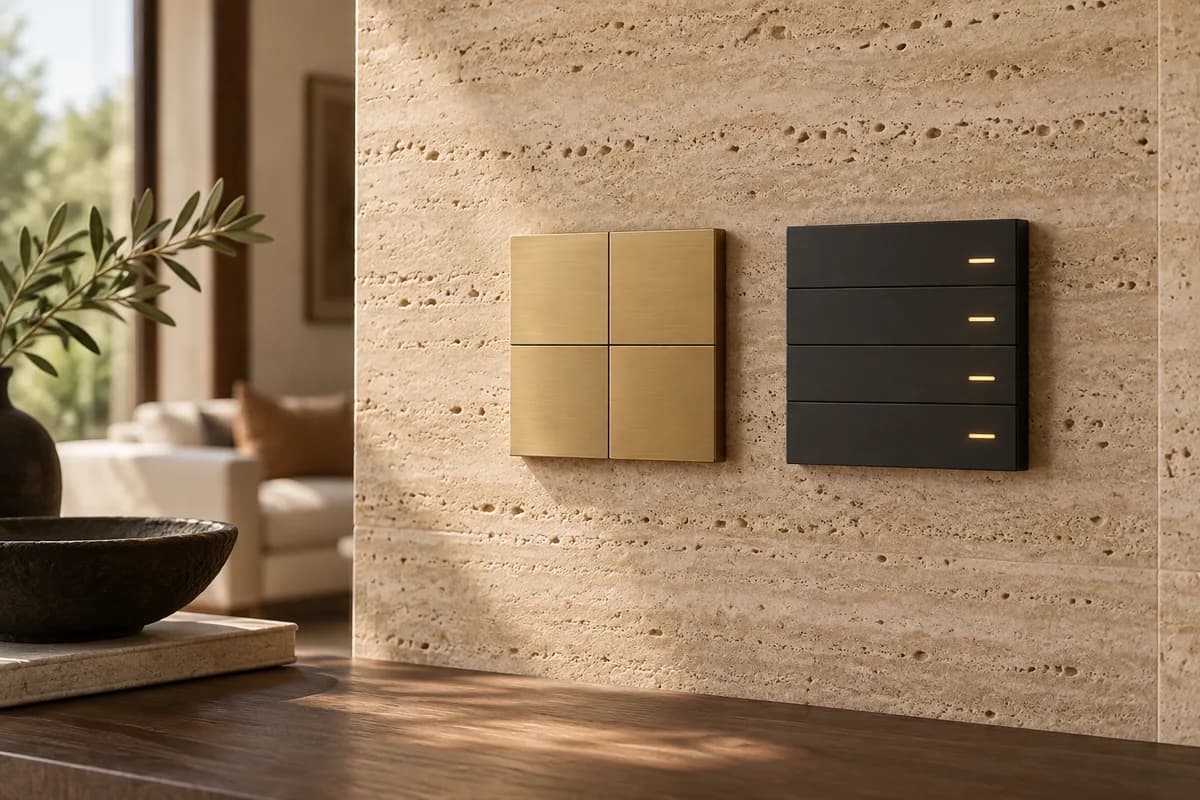
Our recommendation
Shortlist Sentido when a restrained, unlabelled control surface suits the room. Shortlist Fibonacci when visible labels and proximity lighting would help people identify scenes. Confirm the exact system variant and mounting box before ordering either.
Original editorial analysis of manufacturer documentation, not a hands-on review. Prices are a dated website snapshot, not a live offer. Confirm the delivered Indian price, taxes, availability and warranty before purchasing.
Side-by-side comparison
On smaller screens, scroll the table horizontally.
| What to compare | Sentido | Fibonacci |
|---|---|---|
| Control layout | Two or four touch buttons; multi-touch | Two or four touch buttons; multi-touch |
| Visual identification | Minimal touch surface; multicolour LED | Laser-engraved backlit labels/icons; proximity lighting |
| Temperature features | Temperature sensor and thermostat logic | Temperature sensor and thermostat logic |
| Manufacturer-listed systems | KNX, Crestron and Lutron versions | KNX, Crestron and Lutron versions |
| Mounting | Single-gang European wall box | Single-gang European or US wall box |
| Verified India public price | Not found; obtain an itemised quote | Not found; obtain an itemised quote |
Table sources: [1] Basalte: Sentido specifications[2] Basalte: Fibonacci specifications
The important difference is everyday recognition
Fibonacci's labelled, illuminated interface is the clearest functional distinction in the published descriptions. Sentido offers a more visually quiet surface. These are manufacturer-described features; we have not measured responsiveness or compared the finishes in person.
Sources: [1] Basalte: Sentido specifications[2] Basalte: Fibonacci specifications
Our choice depends on who uses the room
For an entrance or guest bedroom, we would prioritise whether a visitor can find the right action without instruction. For a primary bedroom used by the same people daily, a simpler surface may be an attractive trade-off. Neither preference establishes a universal winner.
Before repeating a keypad across the home, mock up one location with its proposed scenes. Have family members explain what they think each control does. Include night-time operation, a cleaner entering the room and someone who prefers an ordinary light switch. This exercise tests the control plan before it becomes an expensive finish decision.
A family name is not a compatibility guarantee
Both product families list KNX, Crestron and Lutron compatibility. Specify the version intended for the proposed system; do not assume one purchased unit connects interchangeably to all three. Ask the integrator to name the part number, required interfaces and the functions delivered in that configuration.
Sources: [1] Basalte: Sentido specifications[2] Basalte: Fibonacci specifications
What an Indian quotation should settle
We did not verify a public India price from the manufacturer. Compare written, delivered quotations using the same finish, button layout and scope. A keypad line item alone cannot establish the installed cost of the scenes it controls.
Coordinate the mounting box with the architect and electrical contractor while wall details can still change. Obtain a sample finish alongside the actual paint, stone or joinery; online swatches are inadequate for signing off a premium material.
- Exact product, system variant, finish and quantity.
- Label artwork and approval process if selecting Fibonacci.
- Wall-box dimensions and any adaptation work.
- Programming, commissioning, GST treatment, lead time and local service responsibility.
What decision are you really making between these keypads?
The practical decision is how people will recognise and operate everyday room functions. Sentido and Fibonacci are visible interfaces within a larger system; the panel on the wall is not the whole automation installation. Start by listing the actions needed at that location, then ask the integrator to demonstrate how the proposed variant performs them. This prevents a finish selection from becoming an assumption about equipment or functions that have not been specified.
A keypad beside an entrance may need a small set of obvious room actions. A bedside location may need different priorities and a less visually prominent arrangement. A family member familiar with the house and a guest arriving for the first time may interpret the same surface differently. Evaluate the interface with those users in mind instead of choosing solely from a product photograph or the number of programmable actions mentioned in a sales discussion.
The comparison table above describes manufacturer-published distinctions. The following guidance is an editorial method for planning a purchase, not a report of hands-on testing. Nexoforma has not installed or independently measured either product. Exact system variants, finishes, installation requirements, local prices and programming commitments must be confirmed in the supplier's written proposal for your property.
How do you decide whether visible labels are valuable?
List the functions a visitor should understand without instruction. Then ask the dealer to show how those actions would be identified on the proposed panel. Fibonacci's published backlit engraving is relevant to that discussion, but the value comes from the actual label choices and their visibility in context. More labels are not automatically better if their wording is unclear or if several actions produce unexpected effects outside the room.
Use meaningful room language when reviewing a label scheme. An action such as reading or evening can be easier to discuss than a programming identifier. However, different households may interpret the same scene name differently. Ask the integrator to demonstrate the result and record it in the scene schedule. A label should point to an agreed behaviour, not merely decorate a surface.
Consider how stable the room's use will be. A permanent label may need a different planning conversation from a function that changes frequently. Ask the supplier about the chosen engraving process, approval artwork, lead time and options if the requirements change. Do not assume that a customised item can be returned or altered on the same terms as an unconfigured standard product.
How should a minimalist control scheme be evaluated?
A restrained interface can work well when the household understands a small set of consistent actions. Test whether that consistency exists across rooms. If the same position performs a different kind of action in every space, the design may demand more learning than its clean appearance suggests. Ask the integrator to explain the proposed interaction pattern and identify any exceptions.
Try the controls from the user's normal position rather than only standing in front of a showroom display. Think about entering with bags, operating a bedside control or asking a guest to switch on a light. These are usability questions, not claims about a product's technical response. A useful demonstration lets the household discover whether the proposed arrangement matches its habits.
Keep frequent actions easy to reach. Optional or rarely used scenes need not occupy the same attention as essential lighting. Ask how the system distinguishes short presses, other gestures or broader scene actions in the selected configuration. Record the exact behaviour in the handover schedule so the installer and users share the same expectation.
What does system compatibility require you to confirm?
Ask for the exact product reference and system variant, not just the family name. The manufacturer identifies compatibility options, but the supplier must confirm which version is being proposed and how it connects to your installation. Record the controller, interface and programming dependencies that are required for the requested functions. Do not assume that every visible panel is interchangeable across different control architectures.
Have the integrator explain the boundary between the keypad and the device controlling the load. A command surface, an actuator and a lighting driver can have different roles. The supplier should identify which components provide those roles in your project and where they appear in the BOQ. This makes the full price more understandable and helps prevent a panel-only quote from being mistaken for a complete room-control solution.
If another trade supplies part of the system, ask both businesses to confirm the interface. The lighting supplier, electrical professional and integrator may each hold information necessary to validate the design. Keep their responsibilities explicit. A brand compatibility statement is a starting point for that conversation, not a substitute for a coordinated equipment schedule.
How should the architect assess finish and placement?
Review a physical finish sample under the intended room lighting where possible. A website image is useful for shortlisting, but it does not establish the precise appearance against paint, stone, timber or metalwork in your project. Ask the designer to consider nearby switches, sockets and door hardware as well as the panel itself. The decision is about the wall composition and daily use, not an isolated product photograph.
Coordinate the location with furniture, doors and circulation. A visually centred panel can still be awkward if it is hidden by an open door or difficult to reach from the normal path into the room. Use the furnished plan and elevations during the discussion. The professional team should determine suitable installation details for the selected model and the actual site conditions.
Ask for the mounting drawing before approving concealed work. The manufacturer-published wall-box distinctions in the table are not a substitute for the exact dimensional and installation documentation supplied for the ordered variant. Have the electrician and integrator confirm the proposed box, wiring arrangement and finish build-up before the wall is closed or decorated.
What should be included in an Indian supplier quotation?
Request the exact reference, finish, quantity and room allocation for each panel. Add any customised engraving or other ordered options as identifiable items. Then separate the supporting system equipment, installation, configuration, coordination and handover. A quotation covering only the visible keypad does not establish the installed cost of the functions demonstrated in a showroom.
Ask for the delivered Indian price, tax treatment, lead time, warranty route and handling of an incorrect or damaged item. Where the product is special order, confirm the approval and cancellation process before procurement. Nexoforma does not publish a verified national installed rate for these panels, and an overseas retail price should not be presented as an equivalent local project quotation.
Include the consequences of changes. If a room's functions or finish choice changes after approval, ask which parts can be revised in configuration and which require new hardware or artwork. Record any additional visit or programming charges. A clear change process is more useful than an informal promise that everything can be adjusted later without cost.
How can you run a fair demonstration?
Prepare the same room brief for both demonstrations. Ask for the same essential actions and comparable scene naming so the exercise focuses on the interface rather than two different automation concepts. Try the controls yourself and invite the household members who will use them. Note where an explanation is required and whether that explanation remains memorable after a short break.
Include ordinary conditions. Review visibility in the sort of lighting the room will use, discuss night-time behaviour and check the proposed label scheme from a normal approach. If a feature is configurable, ask what the quoted configuration includes. Do not assume that a showroom's settings will be copied automatically or that every displayed feature belongs to every system variant.
Record the outcome as preferences and unresolved questions. For example, the family may prefer clearer labels near the entrance and a simpler arrangement in a private room. That is a project-specific preference, not evidence that one product is objectively superior. Ask the integrator whether the mixed arrangement can be implemented consistently and what it changes in procurement or programming.
Can different rooms reasonably use different controls?
Different rooms can have different interaction needs. A shared entrance, a bedroom and an occasional guest room do not necessarily benefit from identical interfaces. Start with a consistent philosophy for common actions, then allow justified differences. The architect and integrator should explain how those differences remain understandable rather than creating a collection of unrelated control conventions.
Keep a room-by-room control schedule. Identify the panel, finish, action assignments, scene names and any dependencies. This schedule becomes a useful bridge between design, quotation and commissioning. It also helps avoid ordering the correct product family in the wrong quantity or placing a customised label in a room whose function later changes.
Discuss spares and replacements with the supplier where appropriate. A mixed set of finishes or customised items may have different procurement implications from a uniform order. Ask what local support can realistically provide and how a replacement would be matched. Avoid treating spare stock as essential without a reason, but make the decision with the supplier's actual availability information.
What should the household know about scenes and exceptions?
A scene is an agreed collection of actions, not simply a button name. Write down the intended effect and the rooms it touches. A whole-home off action, for example, should be defined carefully with the professional team so its scope matches the household's expectations. Do not assume that every connected device should participate merely because it can be controlled.
Discuss what happens after someone makes a manual adjustment. Should a later scene restore a saved state, leave that adjustment alone or perform another agreed action? The answer depends on the design and supported configuration. Ask the integrator to explain the selected behaviour and demonstrate it. Clear expectations reduce the chance that a functioning system is perceived as unpredictable.
Keep essential routines distinct from optional experiments. The family may enjoy refining scenes after living in the property, but it still needs a stable baseline for everyday use. Ask which initial adjustments are included in the service and how further changes are requested. Save an updated scene schedule after changes so the documentation follows the installed behaviour.
Which handover records protect the design intent?
Request the final panel schedule, selected references and finishes, agreed labels and action assignments. Ask which configuration records or backups can be supplied under the chosen system and contract. The customer should know who owns the relevant accounts and how future support is arranged. Keep access credentials separate from documents shared with multiple trades.
Walk through each location during acceptance. Confirm that the physical panel, room name and programmed behaviour match the approved schedule. Note incomplete labels, incorrect scene assignments or outstanding finish issues in a dated list. A systematic room-by-room check is more reliable than a single impressive demonstration of the most elaborate scene.
Discuss future maintenance before closing the project. Ask how a new qualified professional would identify the installed variant and assess its configuration if the original integrator becomes unavailable. Documentation does not guarantee effortless migration, but it reduces dependence on undocumented knowledge. The most attractive control scheme is easier to own when its operation and support path remain understandable.
A practical shortlist for two different households
Imagine a family renovating its main residence and seeking an understated wall appearance. Most rooms need a small set of familiar actions, and the regular users are willing to learn a consistent arrangement. They audition Sentido alongside Fibonacci using those same routines and assess the samples against their finishes. Their decision depends on usability and the complete system proposal, not on the assumption that a cleaner surface means a simpler installation.
Now imagine a home with frequent guests and several shared spaces. The owners place more weight on identifying room functions quickly. They ask the dealer to demonstrate an actual label scheme and review its appearance under normal lighting. They also check the ordering process for customised items and the way future changes would be handled. Their priorities may lead to a different choice without making the first household's preference wrong.
Both examples are illustrative. They are not customer case studies, endorsements or evidence of local stock. Use them to frame your own questions, then obtain a current quotation and demonstration from a suitable supplier. The key decision is whether the chosen interface, system variant and support arrangement fit the people and property it will serve.
Common questions before specifying either model
Can either keypad replace an ordinary switch without other work? Do not assume that. Ask the electrical professional and integrator to assess the actual installation and the required system components. The visible product's size or appearance does not prove that it is a direct replacement for existing equipment or that the wiring is suitable.
Does a temperature-related feature mean the panel alone controls the AC? A published feature should be mapped to the actual HVAC equipment, supported interface and programming in your design. Ask the specialist to explain the complete path and demonstrate the promised function. A sensor or logic capability is not by itself a complete air-conditioning integration.
Which one is better value? Compare the exact variants, finishes, customisation, supporting equipment and installed services. Without current local quotations for equivalent scope, a universal value winner would be misleading. The right choice is the one whose usable benefits justify the complete cost for your household.
Sources and verification
Frequently asked questions
Common questions before specifying either model
Can either keypad replace an ordinary switch without other work? Do not assume that. Ask the electrical professional and integrator to assess the actual installation and the required system components. The visible product's size or appearance does not prove that it is a direct replacement for existing equipment or that the wiring is suitable.
Common questions before specifying either model: point 2
Does a temperature-related feature mean the panel alone controls the AC? A published feature should be mapped to the actual HVAC equipment, supported interface and programming in your design. Ask the specialist to explain the complete path and demonstrate the promised function. A sensor or logic capability is not by itself a complete air-conditioning integration.
Common questions before specifying either model: point 3
Which one is better value? Compare the exact variants, finishes, customisation, supporting equipment and installed services. Without current local quotations for equivalent scope, a universal value winner would be misleading. The right choice is the one whose usable benefits justify the complete cost for your household.
Continue your research
Put your questions into a project brief.
Tell us your priorities and location in India. We will review your request as our professional network grows.
Plan my project →Build a free budget · Draft a project brief · Compare quotations · Check a quote with Ved
Found something that needs correcting? Tell our team. This guide is a planning checklist, not a site-specific design or electrical instruction.
← All guides