THE SHORT ANSWER
What should you know first?
To find a home automation company near you in India, decide the type of provider you need, use official brand and KNX locators as starting lists, and then vet each shortlisted company yourself. Check the GSTIN on the official GST portal, visit or verify real projects, speak to references, and insist on a written scope, support terms and account ownership before you pay.
Our recommendation
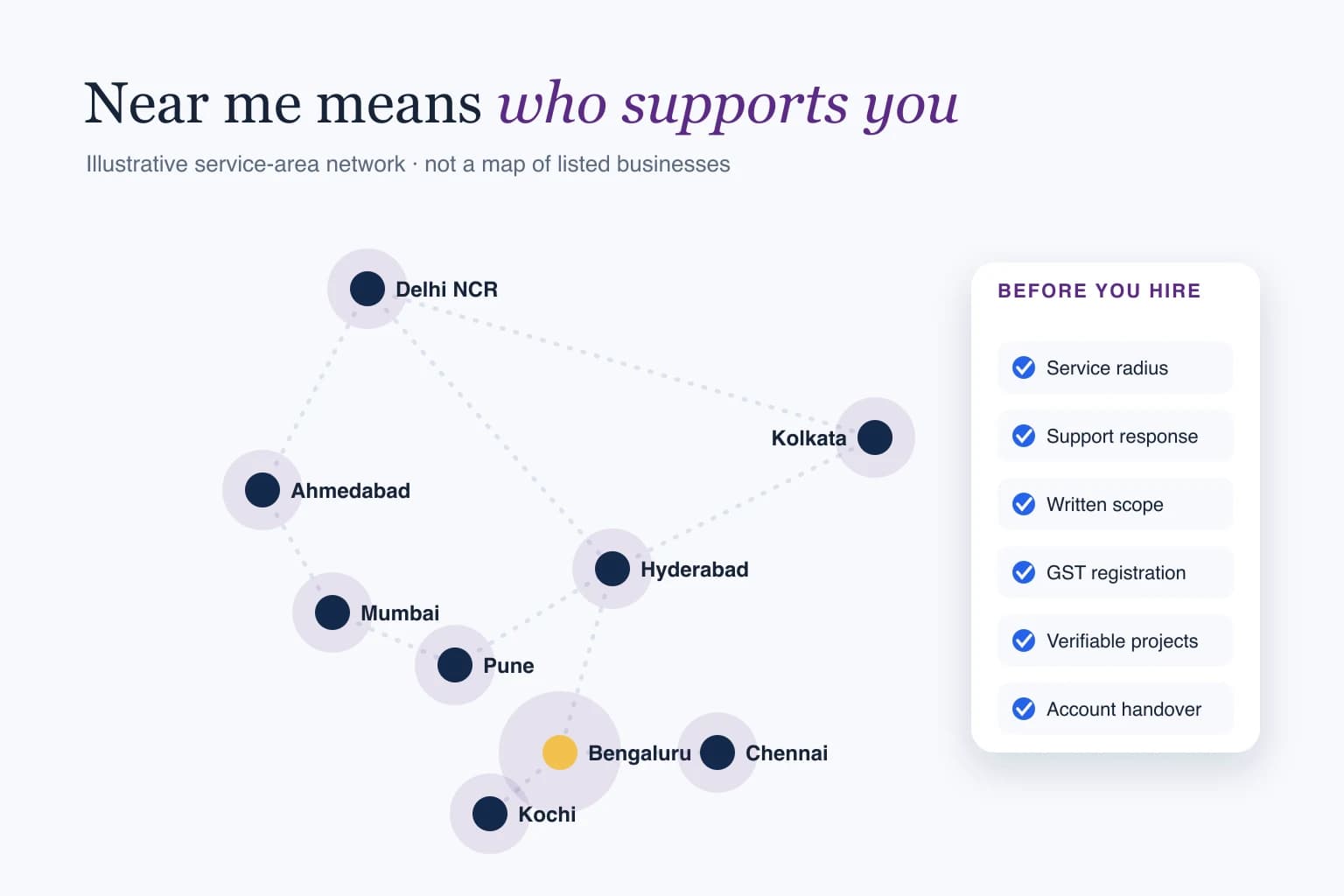
Near me should mean near enough to support you, not merely near enough to sell to you. Start with the kind of company your project needs, use official locators as discovery rather than endorsement, verify the business yourself and compare every shortlisted company against the same written brief. A clear scope, named support arrangements and owner-held accounts matter more than a showroom address or a high rating.
Original editorial analysis of manufacturer documentation, not a hands-on review. Prices are a dated website snapshot, not a live offer. Confirm the delivered Indian price, taxes, availability and warranty before purchasing.
Side-by-side comparison
On smaller screens, scroll the table horizontally.
| What to compare | Who they are | What they usually do | Strengths | What to check |
|---|---|---|---|---|
| Brand-led ecosystems and their dealer networks | Manufacturers of switches, lighting control or whole-home platforms, selling through authorised dealers, stockists or certified integrators listed on the brand's own locator. | Supply the brand's products; certified partners design, install, programme and support systems built on that platform. | Product training, a defined support route back to the manufacturer and a locator you can search by city or country. | Whether the listed business is still authorised, who actually programmes your system, and whether the brand states that dealers are independent and not endorsed. |
| Independent system integrators | Specialist firms that design and commission lighting control, audio-video, networking, security and automation, often across several brands or open standards such as KNX. | Survey, system design, points schedule, programming, commissioning, handover and ongoing service. | Can combine products to fit routines rather than a catalogue, and usually understand networks and programming in depth. | Completed projects you can verify, certifications claimed, who holds the programming files, travel radius and written response times. |
| Electrical contractors offering smart switches | Electricians and electrical contractors who add Wi-Fi or app-controlled switches, modules or panels to their wiring work. | Install smart switches and modules alongside conventional electrical work, often in a single visit. | Already on site, understand the existing wiring and can handle mains work within their competence. | Whether programming, app setup and support are included, neutral availability, warranty route and who you call when the app misbehaves. |
| DIY and consumer smart-home brands | Consumer brands selling plugs, bulbs, cameras, sensors, hubs and voice assistants through retail and online stores. | Sell devices you set up yourself in an app, sometimes with paid installation through the retailer or a partner. | Low commitment, quick to start and suitable for renters or small, room-level upgrades. | Matter or ecosystem compatibility, cloud dependence, subscription costs and whether anyone local will troubleshoot it. |
| Architects and interior firms coordinating automation | Architecture, interior design or design-build firms that bring an automation specialist into a larger project. | Coordinate drawings, switch and panel positions, ceiling and furniture details, and sequencing with other trades. | Can align automation with finishes, lighting design and construction timing before walls close. | Who designs and supports the automation itself, whether the specialist is named in the contract, and the responsible architect's registration. |
Table sources: [1] KNX: Find an Installer (certified KNX partners map)[5] Control4: Find your nearest pro integrator[6] Control4: Why you should use an integrator[7] Lutron: Where to buy directory and independent dealer disclaimer[8] Crestron: Find a dealer or partner[9] Legrand India: Where to buy[10] Schneider Electric India: Find a distributor or integrator[12] Council of Architecture: Search your architect[16] Connectivity Standards Alliance: Matter FAQ
What does home automation near me really mean?
For home automation, near me should mean a company that can reach your home quickly enough to survey it, install it properly and fix it when something stops working, not simply the business with the nearest pin on a map. Automation is a service relationship. Lighting scenes, curtain motors, door locks, cameras and network equipment need configuration changes, firmware updates and the occasional on-site visit for years after the handover.
Think about three distances. The first is the sales distance: where the showroom or office is. The second is the installation distance: where the technicians who will actually work in your home are based. The third is the support distance: who comes when a keypad stops responding or a router is replaced, and how long that takes. A business can have an impressive showroom in a metro and still send a technician from another city, or rely on a local electrician who did not programme the system.
Ask every company to state its service radius for your exact address, the usual response time for a remote fix and for a site visit, and whether visits outside that radius carry travel charges. Response times are not standard across the industry, so treat whatever the company says as a commitment to be written into the support terms, not as a figure you can compare with a published benchmark.
Search engines interpret near me using their own signals. Google's Business Profile help explains that local results are mainly based on relevance, distance and prominence, and that there is no way to request or pay for a better local ranking. That is useful context: the first result is the business that best matches Google's signals, which may or may not be the business best placed to support your particular home.
- Write your exact locality, building type and construction stage before you search.
- Ask where the installation and service team is based, not only the office.
- Ask for remote and on-site response commitments in writing.
- Confirm travel charges for visits after the warranty period.
- Prefer a company whose support route you understand over the closest pin.
Sources: [15] Google Business Profile Help: How local ranking works
What kinds of home automation companies operate in India?
Most homeowners will meet five kinds of provider: brand-led ecosystems with dealer networks, independent system integrators, electrical contractors who offer smart switches, DIY and consumer smart-home brands, and architects or interior firms who coordinate automation within a larger project. The labels overlap, and one business can wear several hats, so judge each company by what it will actually do in your home.
Brand dealers sell and install a particular manufacturer's range. Independent integrators design and commission systems, sometimes across several brands or an open standard such as KNX. Electrical contractors may add app-controlled switches during wiring work. Consumer brands sell devices you set up yourself. Design firms coordinate the drawings and the sequence of trades, and usually bring in a specialist for programming.
The comparison table on this page sets out who each type is, what they usually do, their strengths and what to check. Use it to decide which type suits your project before you collect names. A two-bedroom rental needing a few smart plugs has a different shortlist from a villa under construction with lighting scenes, motorised curtains and multi-room audio.
- Small, room-level upgrade in a finished or rented home: consumer brands or an electrician with smart switches.
- Renovation with several rooms and scenes: brand dealer or independent integrator.
- New build or major renovation with walls open: integrator coordinated with your architect and electrician.
- Large or multi-system home: independent integrator with verifiable programming and support capacity.
Should you hire a home automation dealer or an integrator?
Choose a dealer when you have already settled on a brand and mainly need supply, installation and basic setup; choose an integrator when you need a system designed around your routines, combining lighting, shades, security, networking or audio. In practice, many integrators are also authorised dealers for one or more brands, so the useful question is what role the company will play in your project.
A dealer's strength is product knowledge and a direct route to the manufacturer. The risk is a quotation shaped by one catalogue. An integrator's strength is design and programming across systems. The risk is dependence on one firm's programming files and people. Control4, for example, describes its integrators as using training and knowledge of wiring, networking and audio-video to create installations, and directs current customers to contact their installing integrator for support. That makes the integrator, not the brand, your day-to-day support relationship.
Whichever you choose, ask who designs the system, who programmes it, who commissions it and who supports it. If those are four different businesses, record each one and its responsibilities in the scope.
- Is the company an authorised dealer, a certified integrator, both, or neither, for the products quoted?
- Who writes the programming and who keeps a copy of it?
- Can another qualified professional take over support if the relationship ends?
- Which products in the quote are outside the company's own authorisation?
Sources: [5] Control4: Find your nearest pro integrator[6] Control4: Why you should use an integrator
How do official brand dealer and installer locators work in India?
Most established brands publish a dealer, stockist or integrator locator on their official website, and these are the safest starting lists because they come from the manufacturer rather than an advertiser. Treat them as discovery tools: a listing tells you a business has a relationship with the brand, not that it suits your project or that the brand guarantees its work.
Legrand India's Where To Buy page lets you look for an authorised stockist by selecting a category, then a state, then a city. Schneider Electric India's Find a Distributor or Integrator page links to partner programmes including system integrators and an EcoXpert partner locator, and asks customers to contact its customer care centre to find a nearby service centre. Crestron's Find a Dealer or Partner pages separate commercial dealers, residential dealers and service providers and ask you to search by the nearest city. Control4's Find your nearest pro integrator tool lets you choose a country, including India, and search by location or integrator name.
Read the fine print on each locator. Lutron's where-to-buy directory states that it lists independent distributors, dealers and installers who are not Lutron agents or affiliates, that Lutron is not responsible for their installation work and that it does not endorse any listed company. Control4 explains that its dealer status levels indicate the volume of business an integrator does with Control4 and suggests calling multiple integrators. Neither statement describes quality, so you still need to vet every name.
Locators change, and some only show results for certain countries or cities. If a brand's locator returns nothing near you, ask the brand's official India contact channel which authorised partner covers your town, and then verify that partner as you would any other business.
- Use the brand's own website, not a reseller page claiming to be official.
- Note the listing date or take a screenshot when you shortlist a name.
- Ask the business to confirm its current authorisation for the exact products quoted.
- Remember that a locator listing is not an endorsement or a quality rating.
Sources: [5] Control4: Find your nearest pro integrator[7] Lutron: Where to buy directory and independent dealer disclaimer[8] Crestron: Find a dealer or partner[9] Legrand India: Where to buy[10] Schneider Electric India: Find a distributor or integrator
How do you find a KNX integrator in India?
Use the KNX Association's official Find an Installer map, which lists certified KNX installers as Silver, Gold or Platinum partners and lets you filter by partner level and search within a radius of your location. KNX says Gold and Platinum partners actively offer KNX services and can be contacted directly, and that Platinum partners have reference projects you can view.
KNX is an open standard supported by many manufacturers, so a KNX integrator is not tied to a single product catalogue. That flexibility is only useful if the integrator hands over the project file and documentation, because another certified professional would need them to modify or support the installation later. Ask for the project file, device list and group addresses to be part of the handover.
In India, KNX National India describes itself as advocating for KNX technology and its member base, and says a KNX representative can help you find a KNX system integrator nearby. The KNX Association describes a national group as a neutral, non-profit association and states that KNX National Group India was established in May 2024. A national group can point you to its members, but membership is not the same as a site-specific recommendation.
- Search the official KNX installer map with a realistic radius.
- Ask for the installer's KNX certification and partner level, then cross-check the map.
- Request reference projects you can visit or verify.
- Make the project file and documentation part of the handover.
Sources: [1] KNX: Find an Installer (certified KNX partners map)[2] KNX: One standard, every brand, every system[3] KNX National India[4] KNX: national groups and KNX National Group India
How should you read Google Maps results and online reviews?
Use Maps and review sites to discover names and spot patterns, but never treat the star rating as proof of competence. Google says prominence is partly based on information such as how many reviews a business has and how many websites link to it, which means a well-marketed company can rank above a smaller one that does careful work.
Review manipulation is a recognised problem in India. The Bureau of Indian Standards' conformity assessment scheme for IS 19000:2022 on online consumer reviews describes issues such as false positive reviews written by sellers, false negative reviews written by competitors, online reputation management services, and sellers who reward positive reviews or penalise negative ones. Read reviews with that in mind.
Look for reviews that describe a specific project, a problem that occurred and how it was solved after handover. Repeated comments about slow support, missing programming files or app accounts held by the installer are more useful than generic praise. If a company replies to criticism, note whether the reply is specific and practical.
- Prefer detailed reviews that mention after-sales support.
- Discount bursts of short, similar five-star reviews.
- Check whether the business name on Maps matches its GST legal or trade name.
- Ask references directly instead of relying on public ratings alone.
Sources: [13] Bureau of Indian Standards: Conformity assessment scheme on IS 19000:2022 online consumer reviews[15] Google Business Profile Help: How local ranking works
How do you vet a home automation company before a site visit?
Before inviting anyone home, confirm that the business exists as described, has relevant completed work and will put its proposal in writing. Ten minutes of checking can save a wasted survey and protects your family's personal information.
Start with the GSTIN printed on the company's quotation or website. The official GST portal's Search Taxpayer service lets anyone search by GSTIN and shows the legal name of business, effective date of registration, constitution of business, GSTIN status, taxpayer type, principal place of business and the nature of business activities. Check that the status is active and that the legal name and place of business match what the company told you. A GST registration confirms tax registration; it does not confirm skill or quality.
Next, ask for two or three completed projects similar to yours, with permission to speak to the owners. Project photos are easy to borrow from manufacturers or other firms, so ask for something verifiable: a site visit, a video call from the home, or a reference who can describe the handover and support. If the company works with an architect or interior firm, check the responsible architect's registration through the Council of Architecture's Search your Architect service.
Finally, ask how the company will record your scope. A serious provider will survey before quoting anything beyond a small package, and will be willing to quote against your written brief rather than only its standard bundles.
- Search the GSTIN on the official GST portal and match name, status and place of business.
- Ask for verifiable projects, not just a portfolio of images.
- Speak to at least two past clients, ideally one whose project is more than a year old.
- Confirm product authorisation for the brands quoted.
- Check architect registration where a design firm is involved.
- Share only the personal details needed for the survey.
Sources: [11] Goods and Services Tax portal: Search taxpayer[12] Council of Architecture: Search your architect
What questions should you ask a home automation company?
Ask questions that reveal who will do the work, what exactly is included, and what happens after handover. The answers matter less for their polish than for whether they are specific, consistent and willing to go into writing.
Use the list below during the first call and again at the site survey. Note the answers word for word, because you will compare them across companies and turn the important ones into contract terms.
- Which of your own staff will survey, install, programme and commission my home?
- Are you an authorised dealer or certified integrator for every brand in this quote?
- Can I see or speak to the owner of a completed project similar to mine?
- What does the quote include line by line: devices, model numbers, quantities, wiring, programming, commissioning, GST and travel?
- What is excluded, and what will cost extra if the site differs from the survey?
- Which functions keep working if the internet or your cloud service is down?
- Who will own the app accounts, admin passwords and programming files at handover?
- What is your remote and on-site response time for my address, and is it in writing?
- How long is the warranty on products and on workmanship, and who handles replacements?
- Is there an annual maintenance contract or subscription, what does it cover and what does it cost?
- How will you coordinate with my architect, electrician and network installer?
- What will you demonstrate and test before I sign off the handover?
Sources: [6] Control4: Why you should use an integrator[16] Connectivity Standards Alliance: Matter FAQ
What red flags should make you pause?
Pause when a company will not put its scope, support terms or account arrangements in writing, or pressures you to pay before the scope is settled. These issues are hard to fix after installation, because the system, the programming and the passwords are already in someone else's hands.
Other warning signs include a BHK-based package price with no room-by-room schedule, product names without model numbers, claims of being an official or exclusive partner that the brand's own locator does not support, and portfolio photos that cannot be tied to any real project. Be cautious about an insistence that all apps, hubs and cloud accounts must be registered to the installer, or a reluctance to explain what still works without internet.
A very low quotation is not automatically a red flag, and a very high one is not automatically a sign of quality. What matters is whether the price covers the same scope as the others. If something feels wrong after you have paid, keep written records. The Department of Consumer Affairs' National Consumer Helpline accepts grievances through its web portal, mobile apps and WhatsApp.
- No written scope or a scope that only lists packages.
- Large advance demanded before survey or drawings.
- Unverifiable authorisation or certification claims.
- Installer-only ownership of your accounts and programming.
- Vague answers about support, warranty or exclusions.
- Pressure to decide on the day of the demonstration.
Sources: [7] Lutron: Where to buy directory and independent dealer disclaimer[14] Department of Consumer Affairs: National Consumer Helpline
What should the written scope and support terms include?
The written scope should describe each room's functions, the exact products and quantities, the infrastructure each function needs, the work included and excluded, and the support you will receive after handover. Without that, you cannot compare companies or hold any of them to a promise.
Support terms deserve their own page. Record the warranty on products and on workmanship separately, the remote and on-site response commitments for your address, travel charges, the cost and coverage of any maintenance contract, and the process for replacing faulty devices. Ask whether firmware and app updates are included and who tests the system after a router or internet provider change.
Account ownership is the item most often forgotten. Agree that you, the homeowner, will hold the primary account for every app, hub, camera system and cloud service, with the installer given a separate, removable access if needed. Ask for admin passwords, the programming or project files, a device list with locations and an as-built drawing at handover. If the products use Matter, look for the Matter badge, which the Connectivity Standards Alliance says only Matter-certified devices carry, and record which controller or hub the devices depend on.
Finally, write down what the company will demonstrate before you sign off: each scene, schedule, sensor routine, remote access and the manual fallback when the network is unavailable.
- Room-by-room functions and points schedule.
- Brand, model number and quantity for every device.
- Programming, commissioning, testing and training included.
- Product and workmanship warranties stated separately.
- Written response commitments and travel charges.
- Owner-held accounts, passwords and programming files.
- As-built records and a device list at handover.
Sources: [2] KNX: One standard, every brand, every system[16] Connectivity Standards Alliance: Matter FAQ
How do you find home automation companies in Bengaluru, Mumbai, Delhi NCR and Hyderabad?
In the largest metros, the challenge is filtering too many options, so start with official locators, narrow by the locality the company actually services, and compare shortlisted firms on support rather than showroom size. Name your locality, not just the city, because travel time across a metro can be as important as distance from a smaller town.
Bengaluru: search for home automation companies in Bangalore using your area, such as a specific layout or suburb, and ask how often the company works there. New-build villas and apartments in construction may need pre-plaster coordination, so prefer firms willing to meet your architect and electrician on site. Nexoforma's Karnataka home automation planning page covers questions for Bengaluru and other Karnataka cities.
Mumbai: home automation companies in Mumbai often work in occupied apartments, where society permissions, permitted working hours and limited shaft access shape the job. Ask whether the company has handled society approvals and how it protects finishes. Nexoforma's Maharashtra home automation planning page lists Mumbai, Thane and Navi Mumbai separately, because they are different municipalities with different practicalities.
Delhi NCR: home automation companies in Delhi may quote for Gurugram, Noida, Ghaziabad or Faridabad too, but travel across state lines affects response time. State your actual city in the brief. Nexoforma's Delhi home automation planning page, Haryana home automation planning page and Uttar Pradesh home automation planning page cover the NCR cities separately.
Hyderabad: for home automation companies in Hyderabad, define rooms, network requirements and ownership before comparing control brands, and in a gated community or high-rise ask about gate, camera and intercom coordination and the community's rules for contractors. Nexoforma's Telangana home automation planning page lists Hyderabad and other Telangana cities.
- Search using your locality and building name, not only the city.
- Ask how many recent projects the company has done in your area.
- Confirm society or community rules before the survey.
- Record travel time from the service team's base to your home.
How do you find home automation companies in Pune, Chennai, Kolkata, Ahmedabad, Kochi and smaller cities?
Outside the largest metros, the main question is whether a company can genuinely support your home after the installation, so check where the technicians are based and whether a local partner handles service. A demonstration in a nearby metro does not establish installation or after-sales availability in your town.
Pune: home automation companies in Pune may be based locally or in Mumbai. Ask which team will attend and whether service visits come from Pune. Use Nexoforma's Maharashtra home automation planning page. Chennai: home automation companies in Chennai often coordinate with lighting, air-conditioning and curtain schedules, so ask for a single integrated schedule. Use the Tamil Nadu home automation planning page, which also covers Coimbatore, Madurai and other cities.
Kolkata: in occupied older apartments, make disruption, dust protection and restoration measurable parts of the scope. Use the West Bengal home automation planning page. Ahmedabad: when lighting, shades and audio may come from different suppliers, give each the same room schedule. Use the Gujarat home automation planning page, which also covers Surat, Vadodara and Rajkot. Kochi: if the owner lives overseas, nominate a local decision-maker and keep camera and lock permissions in the owner's control. Use the Kerala home automation planning page.
For Tier 2 and Tier 3 cities, a staged first phase can be sensible: start with the functions you use daily and confirm that local support works before expanding. Nexoforma's location pages cover every state and union territory, with planning questions for each, but they describe planning context only. They do not claim that a verified provider serves every town.
- Ask whether service comes from a local team or a visiting team.
- Confirm travel and replacement arrangements before you order.
- Start with a small, testable first phase if local support is uncertain.
- Use the planning page for your state when writing your brief.
How does Nexoforma's business directory work?
Nexoforma's business directory is an independent research list of architecture, design and home automation businesses, compiled by comparing each business's name, advertised expertise and stated location with its public website. Each card shows the source used and the date it was checked. It is a starting point for your shortlist, not a recommendation.
Listings are not approved partners, paid endorsements, background checks or quality rankings. Businesses appear alphabetically within each region, with no ratings, testimonials or paid priority placements. Source checked describes a review of public information only; it does not establish that a business is trading, will accept your project or holds any particular registration, and no listed business has been contacted as part of the research. No enquiry details are automatically sent to a listed business.
Use the directory alongside the official brand and KNX locators, and run every shortlisted company through the same vetting steps in this guide. If you represent a business and find an error, the directory policy page explains how to request a correction or removal free of charge.
- Treat a listing as a name to research, not an endorsement.
- Follow the source link to the business's own website for contact details.
- Check the date the listing was last source-checked.
- Apply the same GST, reference and scope checks to every name.
Which Nexoforma tools help you compare home automation companies?
Three free tools help you turn a list of names into a fair comparison: the project brief builder, the quotation comparison sheet and Ved's home automation quote checker. Used together, they make every company quote against the same scope, so the differences you see are real.
Start with the project brief to record your home type, city, construction stage, rooms and the routines you want. Send the same brief to every shortlisted company. When quotations arrive, enter them in the quotation comparison sheet so devices, programming, installation, GST, warranty and support terms sit in the same columns, and missing items stand out.
Then upload a quotation to Ved's home automation quote checker. Ved checks the arithmetic, missing items, GST and terms, researches the listed models against Indian listings and suggests questions to ask the installer. Ved explains and checks; it does not choose a company for you or guarantee any provider's work.
- Build one project brief and share it with every company.
- Ask each company to quote against that brief, line by line.
- Put all quotations in the comparison sheet.
- Run each quotation through Ved's quote checker before you negotiate.
What should you do this week to find the right company?
This week, write your brief, build a shortlist of three to five companies from official locators and local research, and run each through the vetting checklist before booking site surveys. A short, well-prepared shortlist will give you better quotations than a long list of rushed calls.
Book surveys with the companies that pass your checks, give each the same brief, and ask for written quotations that follow it. Compare them in the quotation sheet, check them with Ved, and speak to references before you decide. Make account ownership, programming files and support terms part of the contract, and do not pay a large advance until the scope is agreed.
If you are still at the stage of open walls, read the smart home wiring checklist so the infrastructure is ready whichever company you choose, and use the cost guide to set realistic allowances before you meet anyone.
- Day 1: write the project brief and decide which type of company you need.
- Day 2: search official brand and KNX locators, Nexoforma's directory and local results.
- Day 3: check GSTINs and ask for verifiable projects and references.
- Day 4 to 5: book surveys with the companies that pass.
- After quotes: compare, check with Ved, negotiate the scope and support terms.
Sources and verification
- KNX: Find an Installer (certified KNX partners map)
- KNX: One standard, every brand, every system
- KNX National India
- KNX: national groups and KNX National Group India
- Control4: Find your nearest pro integrator
- Control4: Why you should use an integrator
- Lutron: Where to buy directory and independent dealer disclaimer
- Crestron: Find a dealer or partner
- Legrand India: Where to buy
- Schneider Electric India: Find a distributor or integrator
- Goods and Services Tax portal: Search taxpayer
- Council of Architecture: Search your architect
- Bureau of Indian Standards: Conformity assessment scheme on IS 19000:2022 online consumer reviews
- Department of Consumer Affairs: National Consumer Helpline
- Google Business Profile Help: How local ranking works
- Connectivity Standards Alliance: Matter FAQ
Frequently asked questions
How do I find a home automation company near me in India?
Start with the type of company you need, then search official brand locators, the KNX installer map and Nexoforma's business directory alongside local search results. Shortlist three to five names, confirm each GSTIN on the official GST portal, ask for verifiable projects and references, and choose a company whose service team can reach your address within a written response time.
What is the difference between a home automation dealer and an integrator?
A dealer mainly sells and installs one brand's products, often with basic setup. An integrator designs, programmes and supports a system around your routines, sometimes combining several brands or an open standard such as KNX. Many integrators are also authorised dealers, so ask who designs, programmes, commissions and supports your system, and write those roles into the scope.
Are brand dealer locator listings recommendations?
No. A locator shows that a business has some relationship with the brand, not that it suits your project. Lutron's directory, for example, says listed dealers and installers are independent, not Lutron agents, and that Lutron does not endorse them. Use locators to discover names, then verify authorisation, projects, references and support terms yourself.
How do I check if a home automation company is GST registered?
Ask for the GSTIN, then use the Search Taxpayer service on the official GST portal. It shows the legal name, registration date, constitution of business, GSTIN status, taxpayer type and principal place of business. Confirm the status is active and the details match the company. Registration confirms tax status only, not workmanship or quality.
How do I find a KNX integrator in India?
Use the KNX Association's official Find an Installer map, which shows certified installers as Silver, Gold or Platinum partners and lets you search within a radius. KNX National India also says it can help you find a nearby integrator. Ask for certification, reference projects and the project file at handover, so another certified professional can support the system later.
What questions should I ask a home automation company before hiring?
Ask who will survey, install, programme and support your home; whether they are authorised for every brand quoted; what is included and excluded line by line; what works without internet; who owns the app accounts and programming files; the written response time for your address; warranty terms; maintenance costs; and what they will demonstrate before handover.
Who should own the apps and passwords after installation?
You should. Ask for the homeowner to hold the primary account for every app, hub, camera system and cloud service, with the installer given separate access that you can remove. Include admin passwords, programming or project files, a device list and as-built drawings in the handover, so another qualified company can support the system if needed.
Does Nexoforma recommend or verify home automation companies?
No. Nexoforma's business directory is an independent, source-checked research list. Listings are not approved partners, endorsements, background checks or quality rankings, appear alphabetically with no paid placement, and no enquiry details are sent automatically. Use the directory as a starting point and vet each business yourself with the checks in this guide.
Can I trust Google ratings when choosing a smart home installer near me?
Use ratings to spot patterns, not as proof of quality. Google says prominence partly reflects review counts and links, and the Bureau of Indian Standards scheme for IS 19000:2022 describes problems such as seller-written positive reviews and competitor-written negative ones. Prefer detailed reviews about after-sales support, and speak to references directly.
What should I do if a home automation company does not honour its commitments?
Raise the issue in writing with the company first, referring to the agreed scope, warranty and support terms, and keep copies of quotations, invoices and messages. If it remains unresolved, the Department of Consumer Affairs' National Consumer Helpline accepts grievances through its web portal, mobile apps and WhatsApp. Seek professional advice for contractual disputes.
Continue your research
Put your questions into a project brief.
Tell us your priorities and location in India. We will review your request as our professional network grows.
Plan my project →Build a free budget · Draft a project brief · Compare quotations · Check a quote with Ved
Found something that needs correcting? Tell our team. This guide is a planning checklist, not a site-specific design or electrical instruction.
← All guides